
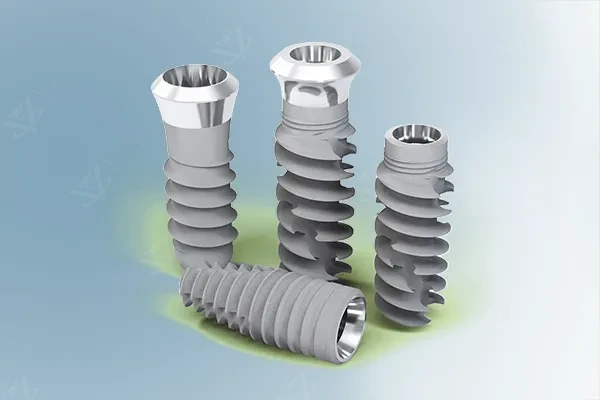
The material of a dental implant directly impacts its success, longevity, and biocompatibility. When a foreign object is placed inside the human body and expected to function for decades, material science becomes everything. At Vision Dental Clinic Abu Dhabi, we believe patients deserve to understand exactly what is being placed in their jawbone and why we choose the materials we do.
Modern dental implantology offers two primary material categories: titanium and zirconia. Each has distinct advantages, and the right choice depends on your clinical situation, aesthetic requirements, and biological considerations.
Titanium Implants: The Gold Standard
Titanium has been the dominant material in dental implantology since Professor Per-Ingvar Branemark discovered osseointegration in the 1960s. More than five decades of clinical research and millions of successfully placed implants have established titanium as the benchmark against which all other implant materials are measured.
Why Titanium Works So Well
There are two primary forms of titanium used in dental implants:
- Grade 4 Commercially Pure Titanium (cpTi) -- the original standard, offering excellent biocompatibility and corrosion resistance with a proven track record spanning over 50 years
- Titanium Alloy (Ti-6Al-4V) -- contains aluminium and vanadium for increased mechanical strength, used in situations where greater load-bearing capacity is required
Titanium's success in implantology comes down to several key properties. It forms a thin oxide layer (TiO2) on its surface within nanoseconds of exposure to air. This oxide layer is what the body actually interacts with, and it is remarkably stable, corrosion-resistant, and biologically inert. The result is osseointegration -- the direct structural and functional connection between living bone and the implant surface.
Straumann Roxolid: A Superior Titanium Alloy
Straumann developed Roxolid, a proprietary titanium-zirconium alloy (TiZr), specifically for dental implantology. Unlike conventional titanium alloys, Roxolid combines approximately 85% titanium with 15% zirconium (the metal, not the ceramic) to achieve significantly higher mechanical strength than commercially pure titanium.
The clinical advantage is substantial: Roxolid enables the use of smaller-diameter implants without sacrificing strength. This is particularly valuable for patients with narrow ridges or limited bone width, where a standard-diameter implant might require additional bone grafting procedures.
Zirconia Implants: The Ceramic Alternative
Zirconia implants are made from zirconium dioxide (ZrO2), a high-strength ceramic material. They represent the primary metal-free alternative in implant dentistry and have gained attention for their aesthetic and hypoallergenic properties.
Advantages of Zirconia
- Tooth-coloured appearance -- the white ceramic material does not show through thin gingival tissue, making it ideal for patients with thin or receding gums in the aesthetic zone
- Hypoallergenic -- an excellent option for patients with known metal sensitivities or those who prefer a completely metal-free restoration
- Low plaque affinity -- the smooth ceramic surface accumulates less bacterial plaque compared to titanium, which may benefit long-term soft tissue health
- Excellent biocompatibility -- zirconia demonstrates strong tissue integration and minimal inflammatory response
Considerations with Zirconia
While zirconia implants offer clear aesthetic advantages, it is important to note that the body of long-term research is smaller compared to titanium. Most clinical studies on zirconia implants have follow-up periods of 5 to 10 years, whereas titanium implants have documented success rates spanning 30 years or more. Zirconia implants are also generally available as one-piece designs, which can limit restorative flexibility in certain clinical situations.
Titanium vs Zirconia: A Direct Comparison
Understanding the differences between these two materials helps you have an informed discussion with your implant specialist:
- Mechanical strength -- titanium alloys (especially Roxolid) offer superior fracture resistance under cyclic loading. Zirconia is strong in compression but more susceptible to fracture under lateral forces
- Osseointegration rate -- titanium with SLActive surface technology achieves the fastest documented osseointegration. Zirconia demonstrates good bone integration, though the evidence base is less extensive
- Aesthetics -- zirconia has a clear advantage in the aesthetic zone, particularly for patients with thin gingival biotype
- Research evidence -- titanium has substantially more long-term clinical data supporting its use. Zirconia evidence is growing but comparatively limited
- Cost -- zirconia implants typically carry a higher cost due to more complex manufacturing processes
- Indications -- titanium remains the first choice for most clinical situations. Zirconia is primarily indicated for anterior cases with high aesthetic demands or patients requiring metal-free solutions
Straumann Surface Technology: Accelerating Healing
The implant surface is just as important as the bulk material. Straumann's surface technologies represent some of the most significant advances in modern implantology.
SLActive Surface
Straumann's SLActive (Sand-blasted, Large-grit, Acid-etched, chemically Active) surface is the result of decades of surface science research. The manufacturing process creates a specific micro-roughness and nano-topography that dramatically enhances the bone healing response.
What makes SLActive unique is the chemical modification process: after sandblasting and acid-etching, the implant surface is rinsed under nitrogen protection and stored in an isotonic saline solution. This preserves the surface's high energy and chemical activity, resulting in osseointegration that is up to 40% faster than conventional SLA surfaces.
For patients, faster osseointegration means shorter healing times, earlier loading of the implant, and a quicker return to full function.
The BLX Implant System
Straumann's BLX implant system combines the Roxolid alloy with the SLActive surface in a design specifically engineered for immediate loading protocols. The tapered geometry and aggressive thread design achieve high primary stability even in challenging bone conditions, making same-day teeth a predictable option for more patients.
Crown and Abutment Materials
The implant post is only one component of the restoration. The abutment (the connector between implant and crown) and the crown itself also involve important material choices:
- Titanium abutments -- the strongest option, ideal for posterior restorations where maximum durability is needed. The grey colour may be visible through thin tissue in the front of the mouth
- Zirconia abutments -- tooth-coloured connectors that provide superior aesthetics in the anterior zone while maintaining excellent strength
- Full-contour zirconia crowns -- monolithic crowns milled from a single block of zirconia, offering exceptional strength and natural translucency
- Porcelain-fused-to-metal (PFM) crowns -- a metal substructure layered with porcelain. Reliable and well-documented, though being replaced by all-ceramic options in many cases
- Lithium disilicate crowns -- glass-ceramic crowns with outstanding aesthetics and translucency, ideal for single anterior restorations
Biocompatibility: How the Body Accepts Implant Materials
Biocompatibility refers to the ability of a material to perform its intended function within the body without causing an adverse biological response. For dental implants, this means the material must not trigger chronic inflammation, allergic reactions, or tissue rejection.
What Makes a Material Biocompatible?
A biocompatible implant material must be chemically stable in the oral environment, resistant to corrosion from saliva and oral bacteria, non-toxic to surrounding cells, and capable of supporting bone cell attachment and growth. Both titanium and zirconia meet these criteria, which is why they are the only two materials widely used in dental implantology today.
Allergic Reactions
True allergic reactions to titanium are extremely rare, with reported prevalence estimated at less than 0.6% of the population. When titanium sensitivity is suspected, patch testing and blood tests (such as the MELISA test) can help identify it. For patients with confirmed titanium sensitivity, zirconia implants provide a proven alternative.
How Vision Dental Clinic Selects Materials
At Vision Dental Clinic Abu Dhabi, material selection is never a one-size-fits-all decision. Dr. Hussien and our clinical team evaluate multiple factors for each patient:
- Location of the implant -- anterior teeth demand higher aesthetic considerations, while posterior teeth require maximum load-bearing capacity
- Bone quality and quantity -- assessed through CBCT 3D imaging to determine which implant size and material will achieve optimal stability
- Gingival biotype -- thin tissue may show the colour of the underlying components, influencing abutment and implant material choice
- Patient health profile -- medical history, allergies, and any material sensitivities are thoroughly reviewed
- Loading protocol -- immediate loading cases may benefit from specific material and surface combinations like the BLX system with SLActive
- Long-term prognosis -- we prioritise materials with the strongest evidence base for long-term success
Our commitment to Straumann as our primary implant system reflects our standard of using only the most clinically documented and scientifically validated materials available. Every implant placed at Vision Dental Clinic is traceable, with a unique serial number and full documentation provided to the patient.