
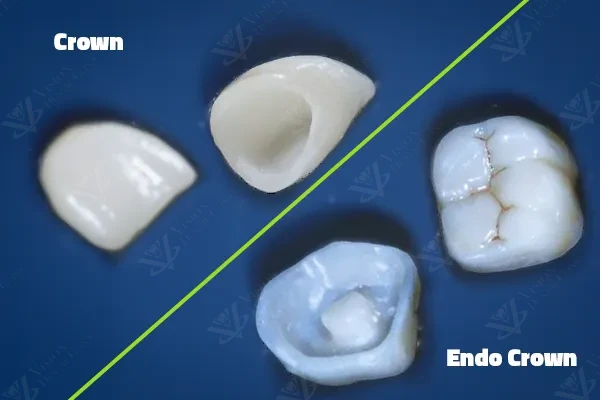
After root canal treatment, choosing the right restoration is crucial for long-term tooth survival. The treated tooth has lost significant internal structure and, without its nerve and blood supply, becomes more brittle over time. How you protect and rebuild that tooth determines whether it serves you for years or decades. Two of the most common restorative options today are the traditional dental crown and the increasingly popular endocrown.
What Is a Traditional Dental Crown in Abu Dhabi?
A traditional dental crown is a cap that covers the entire visible portion of the tooth above the gumline. It encases the remaining tooth structure and restores its shape, strength, and function. Crowns have been a cornerstone of restorative dentistry for over a century and remain one of the most predictable treatments available.
How Root Canal Crowns Work on Treated Teeth
When a tooth has undergone root canal treatment, the internal pulp chamber is empty. In many cases, the remaining walls of the tooth are thin or weakened. A traditional crown approach typically involves:
- Post placement -- a metal or fibre post is cemented into the root canal to provide internal retention
- Core buildup -- composite or amalgam material is built up around the post to recreate the missing tooth structure
- Tooth preparation -- the outer surfaces of the tooth are reduced (shaved down) by 1.5 to 2mm all around to create space for the crown
- Crown cementation -- the final crown is cemented or bonded over the prepared tooth
Crown Material Options
- Full-contour zirconia -- extremely strong, ideal for posterior teeth, available in varying translucencies for natural aesthetics
- Porcelain-fused-to-metal (PFM) -- a metal substructure layered with porcelain. Reliable and well-documented but gradually being replaced by all-ceramic options
- Lithium disilicate (e.max) -- glass-ceramic with exceptional aesthetics and translucency, excellent for anterior teeth
- Gold alloy -- the most biologically kind material with outstanding longevity, though aesthetic limitations restrict its use to non-visible areas
What Is an Endocrown Treatment?
An endocrown is a monobloc ceramic restoration that combines the functions of a post, core, and crown into a single piece. Rather than relying on a post inserted into the root canal for retention, the endocrown anchors itself directly within the pulp chamber of the tooth and covers the occlusal (chewing) surface.
Think of an endocrown as a plug that fills the empty pulp chamber and simultaneously caps the top of the tooth -- all in one solid piece of ceramic.
How Endocrowns Are Different
The endocrown concept was introduced by Pissis in 1995 and later refined by Bindl and Mormann. The key innovation is the retention mechanism: instead of friction-based retention from a post inside the root canal, the endocrown relies on adhesive bonding to the walls of the pulp chamber and the remaining tooth margins.
Endocrowns are fabricated from high-strength ceramics using CAD/CAM (Computer-Aided Design / Computer-Aided Manufacturing) technology:
- Lithium disilicate (IPS e.max CAD) -- excellent aesthetics with high flexural strength, ideal for premolars and molars with moderate functional demands
- Zirconia -- maximum strength for high-load posterior situations, available in multi-layered options for improved aesthetics
Key Differences Between Endocrowns and Traditional Crowns
Tooth Preparation
Traditional crowns require circumferential reduction of the tooth -- removing 1.5 to 2mm of tooth structure from all external surfaces. This is necessary to create space for the crown to fit over the tooth without being over-contoured. Additionally, preparing a post channel removes further internal tooth structure from the root.
Endocrowns require minimal external preparation. The pulp chamber itself serves as the primary retention area, and only a small butt-joint margin is prepared around the top edge of the tooth. Significantly less healthy tooth structure is removed overall.
Retention Mechanism
- Traditional crown -- relies primarily on friction between the prepared tooth (and post-core) and the inner surface of the crown. The taper and height of the preparation walls determine retention
- Endocrown -- relies on adhesive bonding (resin cement) to the enamel and dentin surfaces of the pulp chamber and tooth margins. The bonding surface area can be substantial, particularly in molars with large pulp chambers
Structural Integrity
This is where endocrowns offer a significant advantage. Posts placed inside root canals create a rigid structure that can concentrate stress at the root, increasing the risk of vertical root fracture -- one of the most catastrophic complications in restorative dentistry, as it usually results in tooth extraction. Endocrowns distribute functional loads more evenly across the remaining tooth structure because there is no post acting as a stress concentrator.
When Endocrowns Are Recommended
Endocrowns are particularly well-suited for the following clinical situations:
- Molars and premolars after root canal treatment -- the wide pulp chambers of these teeth provide excellent bonding surface area for adhesive retention
- Teeth with short clinical crowns -- when there is not enough vertical tooth structure to provide adequate retention for a traditional crown, the pulp chamber depth compensates
- Teeth with wide pulp chambers -- larger chambers mean greater bonding area and better retention for the endocrown
- Calcified or narrow root canals -- placing a post in a narrow or calcified canal carries risk of perforation or fracture. An endocrown avoids the root canal entirely
- Teeth with limited supragingival structure -- when minimal tooth structure remains above the gum, an endocrown can utilise the internal chamber for retention without requiring crown lengthening surgery
When Traditional Crowns Are Preferred
Despite the advantages of endocrowns, traditional crowns remain the better choice in several situations:
- Anterior teeth -- the pulp chambers of front teeth are typically narrow and do not provide sufficient bonding area. Traditional crowns also offer greater control over aesthetic outcomes such as colour gradients, translucency, and surface texture
- Teeth with substantial remaining structure -- when most of the tooth is intact after root canal treatment, a full-coverage crown provides comprehensive protection
- Cases requiring splinting -- when multiple adjacent teeth need to be connected (splinted) for stability, traditional crowns can be joined as a bridge
- Teeth where a post provides better retention -- in cases with very little remaining coronal structure and a favourable root canal anatomy, a post-and-core may provide superior retention
Advantages of Endocrowns
The clinical evidence supporting endocrowns has grown substantially over the past decade. Key advantages include:
- More conservative -- preserves significantly more natural tooth structure compared to the post-core-crown approach
- Reduced risk of root fracture -- eliminating the post removes the primary cause of vertical root fractures in root canal treated teeth
- Excellent adhesive bond -- the enamel margins and dentin surfaces of the pulp chamber provide reliable bonding substrates for modern adhesive cements
- Single-appointment fabrication -- with CAD/CAM technology, endocrowns can be designed and milled in a single visit, eliminating the need for temporary restorations and multiple appointments
- Good stress distribution -- finite element analysis studies show that endocrowns distribute occlusal forces more favourably than post-retained crowns, reducing the risk of catastrophic failure
- Simplified procedure -- fewer clinical steps (no post cementation, no core buildup) reduces the risk of procedural errors
CAD/CAM Fabrication at Vision Dental Clinic
At Vision Dental Clinic Abu Dhabi, endocrowns are fabricated using our in-house CAD/CAM digital workflow. The process begins with a digital impression of the prepared tooth using an intraoral scanner -- no messy impression materials required. The scan data is transferred directly to our design software, where the endocrown is virtually designed with precise attention to marginal fit, occlusal contacts, and anatomical form.
The designed restoration is then milled from a ceramic block (lithium disilicate or zirconia) in our in-house milling unit. After characterisation, staining, and glazing in a ceramic furnace, the endocrown is bonded to the tooth using adhesive resin cement under rubber dam isolation. The entire process -- from scan to cementation -- can be completed in a single appointment for most cases.
Digital fabrication eliminates the variability of manual techniques. Every endocrown is milled to micron-level precision, ensuring consistent marginal integrity and optimal fit.
Our team evaluates each root canal treated tooth individually, considering the tooth type, remaining structure, functional demands, and aesthetic requirements before recommending either an endocrown or a traditional crown approach. The goal is always the same: maximum longevity with minimum compromise to your natural tooth.