
What Is Root Canal Treatment?
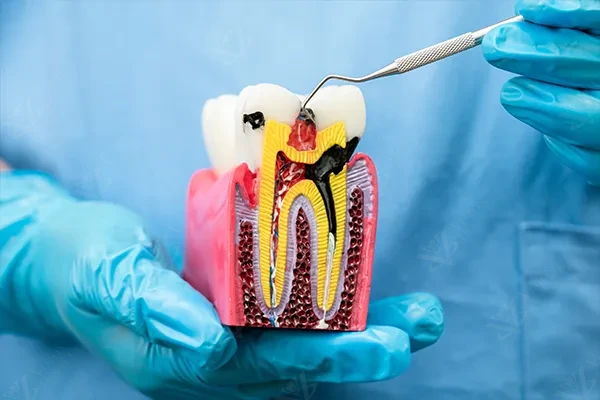
Root canal treatment, also known as endodontic therapy, is a procedure designed to save a tooth that has become severely infected or damaged from within. Inside every tooth lies a soft tissue called the dental pulp, which contains nerves, blood vessels, and connective tissue. When this pulp becomes inflamed or infected, the resulting pain and sensitivity can be debilitating.
During a root canal, the dentist carefully removes the infected pulp from the interior of the tooth, thoroughly cleans and disinfects the root canals, then fills and seals them with a biocompatible material. The goal is straightforward: eliminate the infection, relieve pain, and preserve the natural tooth so extraction is no longer necessary.
Despite its reputation, modern root canal treatment is a comfortable, routine procedure that has saved millions of teeth worldwide. At Vision Dental Clinic Abu Dhabi, we use the latest endodontic technology to ensure every root canal is performed with precision and minimal discomfort.
When Is Root Canal Treatment Needed?
Not every toothache means you need a root canal, but certain signs and situations strongly indicate that the pulp inside your tooth is compromised. Your dentist may recommend endodontic treatment if you experience any of the following:
- Deep decay that has penetrated through the enamel and dentin and reached the pulp chamber
- Cracked or fractured teeth where the crack extends into the pulp, allowing bacteria to enter
- Repeated dental procedures on the same tooth, which can stress and eventually damage the pulp
- Dental trauma from an injury or impact, even if there is no visible crack
- Abscess or infection presenting as persistent pain, swelling of the gum or face, prolonged sensitivity to hot or cold, darkening of the tooth, or a pimple-like bump on the gums
If left untreated, a pulp infection can spread to the surrounding bone, form an abscess, and eventually lead to tooth loss. Early intervention through root canal treatment prevents these complications and keeps your natural tooth intact.
The Modern Root Canal Procedure
Today's root canal treatment bears little resemblance to the painful procedures of decades past. Advances in technology, materials, and technique have made the experience remarkably comfortable and efficient.
Step-by-Step Process
- Local anesthesia: The area around the affected tooth is thoroughly numbed. Most patients report feeling no pain whatsoever during the procedure.
- Rubber dam isolation: A small protective sheet is placed around the tooth to keep it dry, clean, and free from saliva contamination throughout the treatment.
- Access and cleaning: A small opening is made in the crown of the tooth to access the pulp chamber. Using advanced rotary instruments, the dentist carefully removes the infected pulp and shapes the canals with precision that manual files cannot match.
- Electronic apex location: An electronic apex locator is used to measure the exact length of each canal, ensuring complete cleaning and filling right to the tip of the root without unnecessary guesswork.
- Disinfection: The canals are flushed with antimicrobial solutions to eliminate all remaining bacteria.
- Filling and sealing: The cleaned canals are filled with gutta-percha, a biocompatible rubber-like material, and sealed to prevent reinfection.
- Restoration: The tooth is then restored with a filling or, ideally, an endocrown or traditional crown to protect it and restore full function.
A root canal does not kill the tooth. It removes the infection and allows the tooth to continue functioning for years or even a lifetime with proper care and restoration.
What Are Endocrowns?
An endocrown is a modern restorative solution that has transformed how we rebuild teeth after root canal treatment. Unlike a traditional post-and-crown restoration, an endocrown combines the core buildup and the crown into a single, integrated piece that is bonded directly into the pulp chamber of the treated tooth.
Endocrowns are fabricated from high-strength ceramic materials using CAD/CAM technology, ensuring a precise fit and excellent aesthetics. They are particularly well-suited for:
- Molars and premolars that have undergone root canal treatment
- Teeth with short clinical crowns where a traditional post would lack adequate retention
- Teeth with limited remaining tooth structure above the gum line
- Cases where minimal further tooth removal is desired to preserve as much natural structure as possible
Endocrowns vs. Traditional Post-and-Crown
For many years, the standard approach after root canal treatment was to place a metal or fiber post inside the canal, build up a core, and then fit a traditional crown over the top. While this approach remains valid in certain situations, endocrowns offer several compelling advantages:
- Less tooth removal: Endocrowns require significantly less drilling of the remaining tooth structure compared to preparing for a post and separate crown
- Better stress distribution: The bonded, one-piece design distributes biting forces more evenly across the tooth, reducing the risk of root fracture
- Stronger adhesive bond: The large surface area of the pulp chamber floor provides an excellent bonding surface, creating a strong and durable connection
- Faster placement: Because the post, core, and crown are integrated into one piece, the number of clinical steps and appointments is reduced
- More conservative approach: Preserving more natural tooth structure improves the long-term prognosis of the tooth
The endocrown represents a shift toward minimally invasive dentistry, where we preserve as much of the patient's natural tooth as possible while still delivering a strong, long-lasting restoration.
Recovery and Aftercare
Most patients are pleasantly surprised by how straightforward recovery from root canal treatment truly is. Here is what you can typically expect:
- Mild sensitivity in the treated area for a few days is normal and can be managed with over-the-counter pain relief
- Avoid hard or crunchy foods on the treated side for the first few days to allow the area to settle
- Maintain good oral hygiene with regular brushing and flossing, being gentle around the treated tooth initially
- Attend follow-up appointments so your dentist can monitor healing and ensure the restoration is functioning properly
- Schedule regular check-ups every six months to catch any potential issues early
With proper care and a well-placed restoration such as an endocrown, a root canal-treated tooth can last a lifetime, functioning and feeling just like your other natural teeth.
Endodontic Expertise at Vision Dental Clinic
At Vision Dental Clinic Abu Dhabi, our endodontic treatments are supported by advanced diagnostic and treatment technology. We use CBCT 3D imaging to visualize complex root anatomy before treatment begins, ensuring that no canal is missed and the procedure is planned with precision.
Our clinic features rotary endodontic systems for efficient and accurate canal preparation, electronic apex locators for precise measurements, and high-quality biocompatible filling materials. For restorations, our in-house CAD/CAM lab allows us to design and fabricate endocrowns and crowns with exceptional fit and aesthetics, often within the same visit.
Whether you need a straightforward single-tooth root canal or treatment of a complex case with curved or calcified canals, our team has the expertise and technology to deliver predictable, comfortable results.